
Podcast: Play in new window | Download
If you’re a financial advisor out there trying to get new clients, there’s no stronger armor in your quiver than a killer value proposition. I’m going to give you three examples of the value proposition a financial advisor could use – but first I’m going to talk about where you are probably messing it up.
For those of you who are new here, my name is Sara.
- I am a financial advisor marketing consultant.
- I’ve been helping financial advisors get new clients for over 10 years now.
- They appreciate my blunt and clear take on things. Here are some reviews of my financial advisor marketing services.
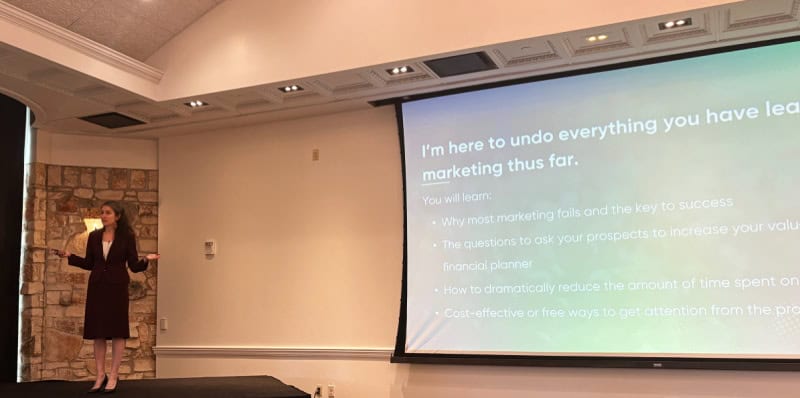
I have a financial advisor lead generation newsletter which is best described as “fun and irreverent.” So please subscribe! I’ve also written these blogs that might be useful if you are a financial advisor who is out there trying to get new business:
AI marketing for financial advisors
Are lead generation services worth it?
Simple and clear LinkedIn prospecting scripts
And now, onto the blog!
First…why is it so hard for financial advisors to articulate a value proposition?
Here’s the real story about why it’s so hard to come up with a good marketing message if you are a financial advisor.
Because y’all are listening to vendors too much.
Yup.
You know who I mean. The product pushers – the custodians, the software providers, the wholesalers with the million dollar marketing budgets. Those are some jargon heavy marketing brochures they send you. Too many technical words, too many marketing slogans, all of that. After a while you get used to talking like they talk because you bought their marketing pitch.
For a very long time, a financial advisor’s value was intrinsically tied to the following:
- How much AUM (asset under management) they had
- The products they sold
- Their investment performance
All of which are closely associated with products sold to you by vendors. Don’t just repitch their marketing pitch to your clients and call it your value proposition!
Don’t listen to them.
Listen to your clients instead.
What is the value of a financial advisor…really?
See, here’s what all of you are missing.
The value proposition isn’t about you.
It’s about them.
Them not you
THEM NOT YOU
Them. not. you
Them, not you.
ThEm NoT yOu
-Sara G
Did I make the point?
So stop flexing about your AUM and start talking about the experience that people actually have as your client!

You have to define value from THEIR point of view, not yours!
You drive a wedge in between yourself and the client when you say something like, “I’ve got the best performance in the industry. Send over your financial statements and ACAT the money, and let me do the work.”
Separate, isolated, non-interactive.
Not really working together, just me following your commands and you following mine.In a way it’s very insidious, because you are disempowering the client. In a sense you have de-involved them.
Plus, alot of you are saying that you have kicka&# performance. However in reality you don’t. And even if you did, you don’t have the audited track record to back it up because you all say that you don’t track performance due to inconsistencies between clients (hard to group into composites.) It’s a false financial advisor client promise that a lot of you make.Then the market crashes and then you’ve got people running like a bullet to the next advisor.
Because you’ve defined your value by a product instead of what the core of your marketing message should be as a financial advisor: their ability to benefit from the communication and guidance you give them about how they should build their wealth!
Let’s look at an entirely different way to differentiate yourself as a financial advisor who doesn’t just push products, fiduciary status, performance, or their “20 years of experience serving clients just like you” (sigh).
They smacked me upside the head with their brand messaging
What makes a customer value an experience they had with a brand?
I had a tremendously memorable donation experience a few years ago. I hate the suffering in Afghanistan and I donated to the International Rescue Committee. A few weeks later, I got a phone call. An Afghan woman called me to personally thank me for helping her people. Then a few weeks after that I got an email with some Afghan recipes.
Unbelievable.
It went way beyond those return labels they usually send you. It’s not that I don’t appreciate having not having to write about my return address, but this made me feel:
- Like I was a part of them.
- Like I was part of their culture and their family, in a way.
- It was emotionally fulfilling to hear a woman speak with an Afghan accent. I have never directly had someone call me and speak with such an accent. It was new.
- I learned about Afghan cuisine. I had never seen the food before in that recipe.
- I felt special, like they were thinking about me. I donated to a bunch of other charities and nobody did that.
If I had to donate again, I’d donate to the IRC over any other charity. To put it bluntly, that was great value for my money donated because there was great emotion in that experience.
Great financial advisor brands create great feelings
The best financial advisors are those who make it not about the papers and the balances but about the client’s personal growth. They don’t just change the client’s money, they change the client by making them grow – growing in knowledge, in mindset, exercising better behaviors. Not just learning, but almost as if they’ve been trained on how to behave.
That way no matter what way the market goes, college tuition rates go, life goes, no matter who lives or dies or gets sick or not, they feel more in control and as if they can make better decisions in response to whatever happens. It’s not what you do for them, the words on a piece of paper, the numbers in the account.
Here’s a little psychological hack:
It’s harder for people to devalue something they are a part of.
The way that human psychology works, we naturally view something as more valuable if we are a part of it. If wefeel we are a part of it, connected to it.
Guess what.
Most of you don’t do anything that different. Either you use eMoney or MoneyGuidePro. Either you custody at Schwab or Fidelity. There are some outliers but for the most part, you are all doing the same thing. The service is a commodity; the feelings about the service are what make you valuable!
So you have to reverse engineer this and focus on things from the client’s point of consciousness. Remember “you, not them” like I said earlier? Let’s nail down what that means, in specific terms.
Checklist: What makes a great financial advisor value statement?
Here’s a checklist of what makes an awesome financial advisor value proposition. It clearly explains:
- Why their clients picked them over other advisors
- What problems you solve better than anyone else in wealth management
- The client outcomes that people regularly experience and appreciate
- The annoying things that other financial advisors do to their clients that you do not
- What the characteristics are of who you serve (age, geographic area, profession, net worth, etc)
- Who your wealth management services are the most valuable to, and why
- The types of clients who are not a great fit for your services
- Any niche focus your practice has
- What you are willing to do for your clients that other financial advisors won’t do
- What your client testimonials say
- What client success looks like
Nothing about products, performance, or outperforming the S&P 500 is on that list, folks!
Alright, so let’s get to the good stuff: financial advisor value proposition examples. Here’s how you would explain your value as a financial advisor (in two sentences or less!)
But actually – just one quick question before we jump into it – are you enjoying this blog?
If so, you might want to consider setting up some time with me. There are a variety of ways that I help financial advisors get new clients.
Here are what other financial advisors have said about working with me:
The great thing about working with Sara is she has a finance background so she can write content that is technical and specific. She is organized, always does what she says she is going to do and kept us accountable to get our tasks done. Over time working with her we went from rarely having a new prospect from our website to getting regular, qualified prospects through the website. And she helped us publish a weekly newsletter and made sure it always went out on time.
– Nicole Roberts, CFP®, Rock House team at Wealth Enhancement Group
And now, without any further ado, here’s some scripts to use to express your value as a wealth advisor.
If you want to answer the question of “what’s my value proposition?”, here are three examples of how you could do that. These could also be used as banking value proposition examples, or also value proposition examples for insurance agents.
Example #1: The learning value proposition
There is great value in an advisor who makes the client feel better informed.
Guess why this matters – here’s a hint. Most people wouldn’t need a financial advisor if they thought they could do it on their own. And why can’t they? They’re smart people, right?
Some are probably even smarter than you!
It’s not for a lack of knowledge – it’s behavioral bias that leads them to seek you out. Biases like confirmation bias, action bias, herd bias, anchor bias. All of the psychological tricks our mind plays on us that lead us to make bad decisions with money and investments.
Use this to justify your value as a financial advisor.
What knowledge can you give your clients, so they can behave better?
Take three steps to learn how to articulate that.
Step #1
Make a list of all the things that your clients learn from working with you. Get 50 specific things on the list.
Here’s a start:
- Clients learn to look out each year for the Social Security cost of living increase.
- Clients learn about what inflation is and how it impact them.
- Clients learn how tax treatment of small donations is changing under new tax law
See, because here you’re really getting at what the value is that you provide, but it’s from the standpoint of THEIR experience not yours.
You need 50 things on this list
If you don’t know 50 things, start asking your clients, “what have you learned by working with me?” Yes, you will have to work hard.
Step #2
Look at the list of 50, and pick out 1) the learning that applies most universally to the greatest number of clients and 2) the most powerful learning that any one client has had.
Step #3
Then say these words (fill it in with your personal results from #3).
Somebody says, “Why should I pay you $12k a year?”
You say:
“The most universal gain that my clients take away from working with me is the understanding of how their estate planning impacts their legacy. The best example of this was when a client was able to make a $5MM donation to a charity using gifting strategies they learned from me,and they otherwise would not have been able to do so.”
#2 The humble value proposition
You have to be willing to give them permission to throw the relationship out the window. Because you take it and throw it out the window first. It takes the pressure off.
They say, “Why should I pay you $12k a year?”
Say these words:
“There are a lot of advisors who do what I do. Some of them say they’ll get you the best return. Some of them say they’ll save you the most taxes. I can’t say any of those things and believe it and I personally think those advisors are exaggerating anyway.
My value is the impact it has on my clients’ ability to make decisions in their daily lives. My clients, who are usually between 55 and 70 years old living in southern Alabama, feel more comfortable navigating the many decisions they need to make in retirement, and specifically the taxes and healthcare obstacles they may face that get them emotional and vulnerable to mistakes. I teach through experiences and outcomes, and I stay objective and clear when my clients go through confusing times.”
#3 The simple value proposition
Brevity is rare in these types of financial advisor value proposition declarations because people get really nervous and ramble. If you can make a simple statement and then shut up, you just may win the client over.
Three brief financial advisor value proposition examples:
- “I’ve come to save you from the backbreaking tax rates that you will slaughter you if you retire here in Manhattan and that is worth way more than $12k.”
- “I’m here to be the easiest person in the world for you to communicate with about your money while you are busy being a neurosurgeon, and for that reason alone I am worth the $12k you will pay me this year.”
- “I’m here to save you from being your own worst enemy because as we all know, our mind plays tricks on us with money sometimes.”
You can only say this when you’re sure you know who you’re talking to. This is not an elevator pitch, or the opening line of the meeting. It’s the summary line, kind of like the exclamation point that goes at the end of the meeting. Over the course of the meeting you’ll need to have listened to them to know what unique needs they may have – and that’s how you justify your value as their wealth manager.
What about a financial planner value proposition?
How do you express your value if you are a financial planner who doesn’t provide investment management services at all (advice only planners, for example). People don’t buy financial planning services on fluffy, feel good “mission statement stuff.” How do you describe financial planning so people feel it’s a ‘must have?’
Say this:
“Instead of focusing on market movements that nobody can control anyways, my sole focus in your life. I do math equations so people don’t mess up big financial decisions and permanently ruin their lives.”
Raw.
It doesn’t flow well, and it doesn’t even make grammatical sense.
But they’ll get what you mean, for sure.
Yes, this is hard work
Work hard to express your value. Yes, you will have to devote time and energy to figuring this out. But the alternative is sounding like everyone and else and that gets you nowhere.
Over the last 10 years, I’ve helped other financial advisors to come up with a value statement. Here is what those advisors would say helped them the most:
- Ask your clients what they value about your wealth management services. It’s always better if you don’t have to guess!
- You might even do a feedback survey to get a broad sampling.
- Ask clients to review your service or provide testimonials, and see what they say.
- Write your marketing message down and run it by your employees, clients, and even other financial advisors you trust.
- Keep it brief. A value statement should be no longer than two sentences.
- Test it out with prospects and see how they respond. Pay careful attention to their body language.
- Don’t give up! There may be a few permutations. Very few advisors nail their value statement the first time.
And now for the blunt truth…
Are you actually delivering what you say you are?
Some of you may not actually be providing that much of value as a wealth manager.
Yup.
There.
I said it!
You may not be giving to them other than the nuts and bolts of the service offering and hoping that they’re satisfied enough with the performance that they don’t ask too many questions.
If you are fighting with your clients, not getting enough referrals, fighting over fees or performance, you need to work on this. You need to work on communicating with them in a way that educates and trains them, because when they feel like they understand what is going on you they will see more value in you. Because then they’ll see why they can’t do it better and they wouldn’t want another advisor to do it better because you communicate with them better than anyone else.
If you are losing clients due to fees, performance, couldn’t get them to come to your meetings, you need to work on this. You may have to learn a few things from other advisors. But most of all, you’ll learn it from your clients because it is in the experience they have that is where the value lies (or not).
How can a financial advisor marketing consultant help me?
I am a financial advisor marketing consultant. For over 10 years I’ve been helping financial advisors get new clients by expressing their value and presenting it to the world in a variety of ways.
Here are what a few more of my clients had to say about me:
I have worked with Sara Grillo over the last few years and she did an amazing job with our Linked-In platform. In the short period of time she took my followers from roughly 5000 to nearly 15000 and helped me grow my newsletter to over 30,000 subscribers. If you are needing help growing you social media and your business, Sara is a great resource. (five stars, highly recommend.)
– Lance Roberts, Chief Investment Strategist, RIA Advisors
If you’d like, you can read more testimonials about my financial advisor marketing services.
Alright let’s wrap it up!
- I am an outsourced CMO for financial advisors who need regular, full service marketing – blogging, social media posts, newsletters, etc.
- I am an hourly consultant for those who just need one-time or recurring guidance
- People hire me as a ghostwriter to write content for a project fee
- If you aren’t ready to engage, at least sign up for my financial advisor marketing tips newsletter and receive one lead generation tactic a day in your inbox!
If you would like to discuss how I can help, please send me a note.
See you in the next one!
-Sara G
Sources
OpenAI. (2026). ChatGPT powered by GPT-4.1 [Large language model]. https://chat.openai.com/chat. Prompt: questions financial advisors ask about value proposiiton